
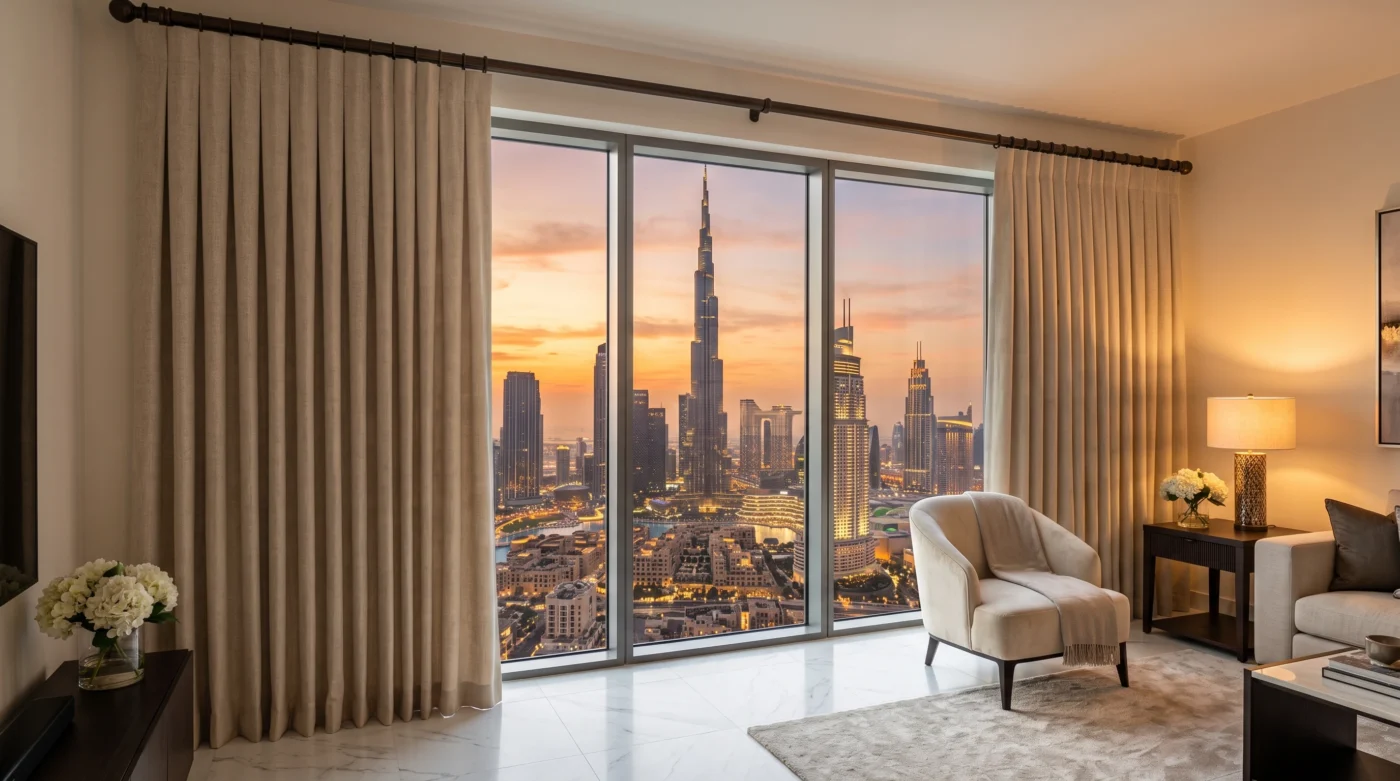
If you are searching for inverted pleat curtains Dubai, you are probably looking for something more refined than ordinary curtains but less traditional than heavily gathered drapes. Inverted pleats create a clean, architectural appearance because the folds turn inward instead of projecting prominently toward the room. The result is a curtain that looks tailored, structured and contemporary while still providing the softness that makes fabric window treatments attractive. In Dubai, where many apartments, villas and offices feature large windows, high ceilings and floor-to-ceiling glass, this understated style can work particularly well because it complements rather than competes with the architecture.
Our Famous Products, Buy Now:
- Fabric Vertical Blinds
- Roman Shades
- Sheer Roman Blinds
- Wave Style Sheer And Blackout Curtains
- Wooden Blinds
The demand for made-to-measure curtains in Dubai continues to reflect the city’s preference for customized interiors. Current Dubai curtain suppliers advertise a broad selection of made-to-measure fabrics, headings, tracks and lining options, while published 2026 pricing shows that custom curtain costs can vary considerably according to fabric, dimensions, fullness, lining and installation requirements. That makes choosing the heading style only one part of the decision. You also need to think about the fabric weight, sunlight exposure, privacy requirements, track system and the overall personality of the room.
What Are Inverted Pleat Curtains?
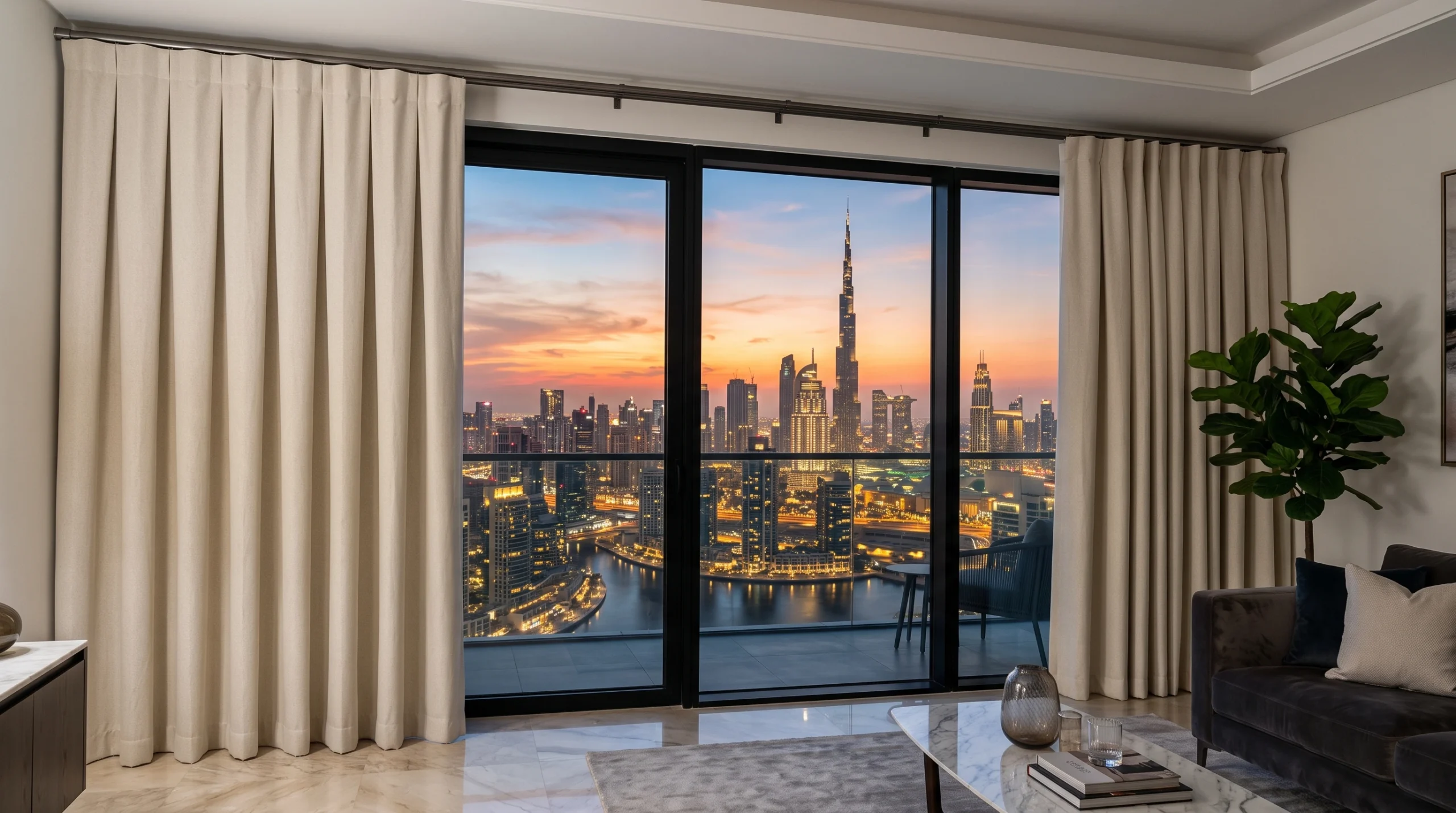
Inverted pleat curtains are made by folding fabric inward at regular intervals so that the visible front of the curtain remains comparatively flat and streamlined. Unlike traditional pinch pleats, where the gathered folds are visibly pinched together at the top, inverted pleats hide the fullness behind the face of the curtain. This creates a cleaner visual line and gives the fabric a more contemporary character. Several Dubai curtain suppliers describe the style as having an inward-folding construction and a sleek, flat-front appearance, making it particularly suitable for modern interiors.
Think of the difference like tailored clothing. A heavily gathered curtain is similar to a formal garment with visible decorative folds, while an inverted pleat curtain is closer to a sharply tailored suit where the structure exists but does not shout for attention. That subtlety is exactly why the style works well in contemporary Dubai homes. It can frame a window beautifully without making the curtain itself the main decorative feature.
How the Inverted Pleat Design Works
The construction starts with carefully calculated fabric fullness. The curtain maker determines how much fabric the window requires, marks the pleat positions and folds the material inward before securing the heading. The exact construction can vary according to the curtain maker, fabric and track system, so a professional measurement is important when the goal is perfectly aligned folds.
The advantage is visual consistency. When the curtain is closed, the folds can create a series of controlled vertical lines rather than a busy collection of outward-facing pleats. When the panels are opened, the fabric stacks toward the sides and can create an elegant frame around the glass. For wide Dubai windows, that controlled appearance can make a large expanse of fabric look intentional rather than excessive.
Why Inverted Pleat Curtains Are Popular in Dubai
Dubai interiors often combine clean architectural lines with luxurious materials. You might have marble flooring, recessed lighting, large glass doors, neutral walls and bespoke furniture in the same room. A curtain with an overly decorative heading can sometimes introduce visual noise into that composition. Inverted pleat curtains offer another approach: they bring softness, privacy and light control while keeping the overall appearance disciplined.
They also suit the scale of many Dubai properties. Floor-to-ceiling windows are common in modern apartments and villas, and made-to-measure curtain suppliers specifically highlight the need to accommodate large glass areas, unusual heights and wide spans. Instead of forcing a standard curtain size into an oversized opening, a custom inverted pleat design can be proportioned to the actual window.
The Clean Look for Modern Dubai Interiors
The strongest visual benefit is simplicity. A neutral beige, ivory, greige or warm-grey fabric with inverted pleats can disappear into the interior while still giving the room a finished appearance. This is especially useful when the design already contains statement elements such as a sculptural sofa, feature wall, artwork or dramatic lighting.
The style also works beyond minimalist interiors. Pair it with velvet and you can create a richer, more luxurious atmosphere. Choose linen or a textured blend and the same pleat structure becomes relaxed and organic. Select a blackout fabric for a bedroom and the curtain becomes primarily functional. The heading stays consistent while the material changes the personality of the room.
Inverted Pleat vs Pinch Pleat Curtains
The difference between inverted and pinch pleats is largely about where the visual emphasis sits. Pinch pleat curtains gather fabric at the top into visible folds, producing a classic and decorative appearance. Inverted pleats turn the folds inward, producing a flatter face and a more restrained look. Dubai suppliers currently offer both styles as custom-made options, with double and triple pinch pleats commonly positioned as more traditional or formal choices and inverted pleats marketed toward cleaner contemporary interiors.
| Feature | Inverted Pleat | Pinch Pleat |
|---|---|---|
| Overall appearance | Clean and contemporary | Classic and decorative |
| Visible folds | Subtle | Prominent |
| Best interior style | Modern, minimalist, transitional | Classic, luxury, formal |
| Visual weight | Controlled | Fuller and more substantial |
| Fabric choice | Linen, blends, blackout, velvet | Linen, velvet, jacquard, blackout |
| Suitable for villas | Yes | Yes |
| Suitable for apartments | Yes | Yes |
| Custom measurement | Recommended | Recommended |
Which Curtain Style Looks More Contemporary?
If your home has straight lines, neutral colours, modern furniture and simple architectural detailing, inverted pleats are usually the more natural choice. They have enough structure to look premium but do not introduce the ornamental appearance associated with some traditional pleat styles. This makes them particularly useful in modern living rooms, bedrooms, dining spaces and executive offices.
Pinch pleats still make sense when you want the curtains to contribute more decorative character. There is no universal winner. The right choice depends on whether you want the curtain to blend into the architecture or become part of the room’s visual statement.
Best Fabrics for Inverted Pleat Curtains in Dubai
Fabric selection matters just as much as the pleat itself. A beautifully constructed heading cannot compensate for a fabric that hangs poorly, fades quickly or fails to provide the privacy required by the room. Current Dubai curtain ranges include linen, velvet, polyester, sheer, blackout and blended fabrics, with different materials positioned for different budgets and applications.
For everyday living areas, textured linen blends can provide a relaxed luxury appearance. For bedrooms, blackout-backed fabrics can provide better control over daylight and privacy. Sheer fabrics work well when the priority is softening sunlight while preserving a brighter daytime atmosphere. Velvet or heavy jacquard can create a more dramatic appearance in formal rooms, although the extra weight should be considered when selecting the track and installation system.
Blackout, Linen, Sheer and Velvet Options
Blackout fabric is particularly useful for bedrooms and media rooms where light control matters. Sheer fabric is useful when you want daylight and a degree of privacy without closing the room off visually. Linen and linen blends suit contemporary interiors because their texture adds interest without relying on strong patterns. Velvet provides a heavier, richer appearance and can work beautifully in luxury villas, majlis areas and formal entertaining spaces.
For Dubai’s climate, consider the window’s exposure rather than choosing fabric based solely on appearance. A west-facing glass wall receiving intense afternoon sun has different requirements from a shaded bedroom window. A dual-layer arrangement, such as sheer plus blackout, can provide more flexibility because you can filter daytime light and close the heavier layer when you need privacy or darkness.
Inverted Pleat Curtains for Dubai Villas
Large villas give inverted pleat curtains plenty of room to show their strengths. Double-height spaces, wide sliding doors, formal dining rooms and floor-to-ceiling windows all benefit from a heading that creates a consistent vertical rhythm. Instead of allowing a large amount of fabric to become visually chaotic, the inverted construction gives the drapery a tailored character.
The key is proportion. A small window does not necessarily require extremely full curtains, while a huge opening can look underdressed if the fabric volume is too low. Custom curtain suppliers note that Dubai pricing and fabric requirements change according to window width, ceiling height, fullness and whether the installation involves bays, corners or double tracks. For a villa, an on-site measurement is therefore far more useful than ordering by a generic window size.
Inverted Pleat Curtains for Apartments
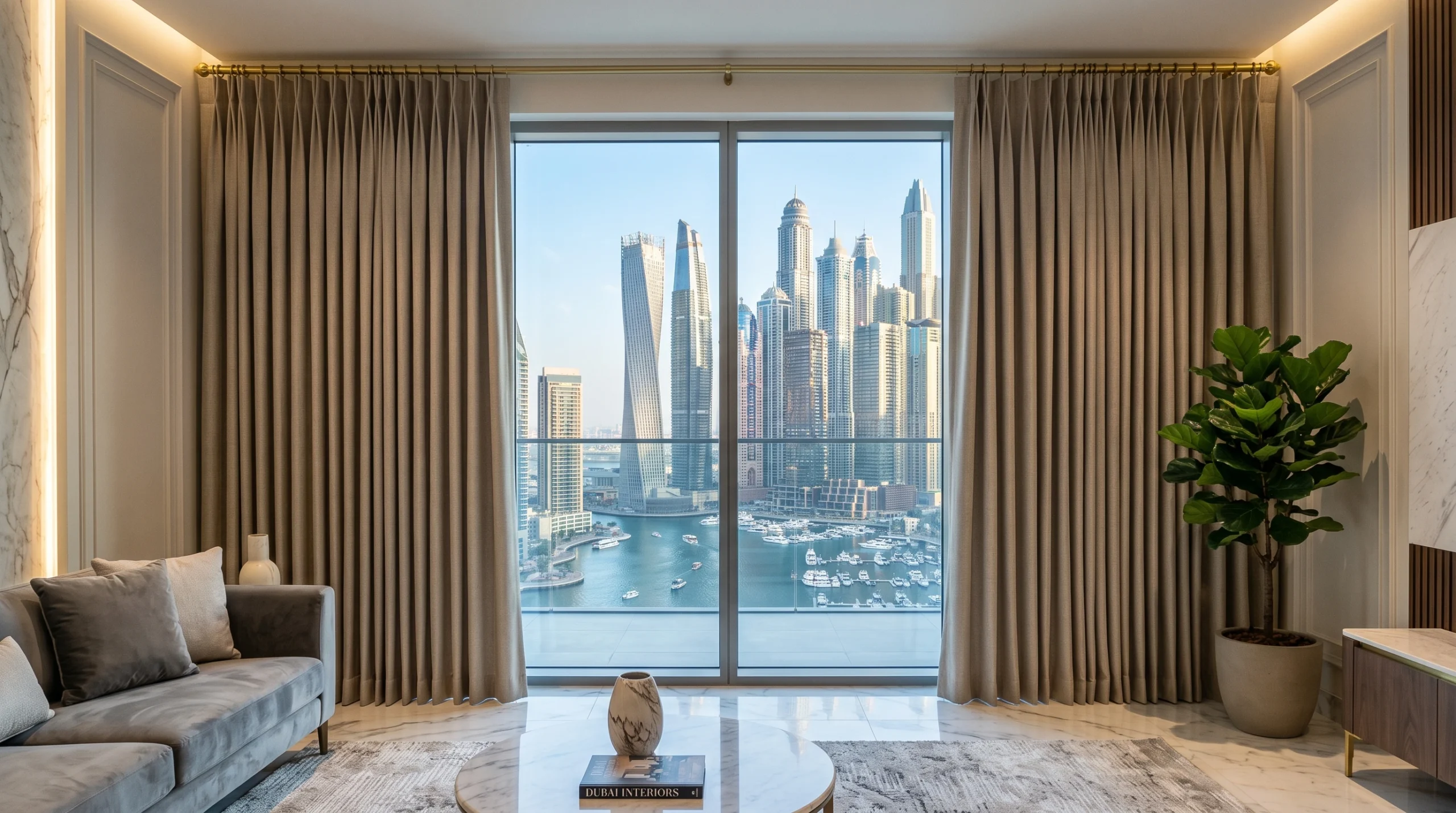
Apartments present a different challenge. Space can be limited, and the curtain should enhance the room without making it feel crowded. The flat-front quality of an inverted pleat can be useful here because the design feels neat and intentional rather than heavily ornamental.
For a Dubai apartment, consider using a ceiling-mounted track when appropriate. This can draw the eye upward and make the window appear taller. A floor-length neutral curtain can also visually connect the ceiling and floor, creating a longer vertical line. In compact rooms, lighter fabrics and softer colours can help maintain an open feeling, while blackout lining can still provide practical privacy when required.
Choosing the Right Curtain Fullness
Fullness determines how much fabric goes into the curtain relative to the width of the track. More fullness creates a richer, deeper appearance, while less fullness produces a flatter and more economical treatment. Current Dubai curtain guidance commonly discusses fullness as a major factor in both appearance and cost, with one supplier reporting typical custom work around 230% fullness while also offering lower fullness for a softer look.
With inverted pleats, fullness should be chosen carefully because the whole appeal of the design depends on controlled folds. Too little fabric can make the curtain look thin and unfinished. Too much fabric can make the pleats visually heavy and increase the amount of material required.
How Fullness Changes the Final Appearance
Imagine two identical windows. One uses a relatively modest amount of fabric and creates a restrained, streamlined appearance. The second uses significantly more fabric, producing deeper folds and a more luxurious stack. Neither is automatically better; the correct choice depends on the room, fabric weight, budget and desired level of luxury.
For a premium Dubai interior, discuss fullness during the quotation rather than treating it as an invisible technical detail. Ask how much fabric will be used, how the pleats will be spaced and how the finished curtain will stack when open. These details can make the difference between a curtain that simply covers a window and one that looks genuinely bespoke.
Inverted Pleat Curtains for Floor-to-Ceiling Windows
Floor-to-ceiling glass demands precision. A curtain that stops several centimetres above the floor can immediately look poorly fitted, while an excessively long curtain can bunch unattractively. Made-to-measure Dubai suppliers specifically highlight ceiling-to-floor drops and oversized glass configurations as situations where custom measurement becomes important.
For these windows, the track position also matters. Depending on the architecture, a ceiling-mounted track can create a seamless visual transition from ceiling to fabric. If the room has a pelmet, cornice or concealed curtain pocket, the track can be integrated so the curtain appears to emerge directly from the architecture. The result is particularly effective in contemporary villas and apartments where large glass surfaces are part of the design.
Can You Use Inverted Pleats With Blackout Curtains?
Yes. Inverted pleat blackout curtains can combine the tailored appearance of the heading with the practical benefits of light control and privacy. The important detail is not simply choosing a dark-looking fabric. Blackout performance depends on the fabric or lining construction, and the overall installation also needs to address gaps around the sides and top.
For bedrooms, consider whether you want a single blackout layer or a combination of sheer and blackout curtains. A dual-layer setup gives you more control: the sheer layer can remain closed during the day while the blackout curtain handles stronger sunlight and nighttime privacy. Current Dubai curtain pricing examples show that dual-layer curtain packages can cost substantially more than basic single-layer treatments because they combine additional fabric, hardware and installation requirements.
Curtain Tracks and Installation Options
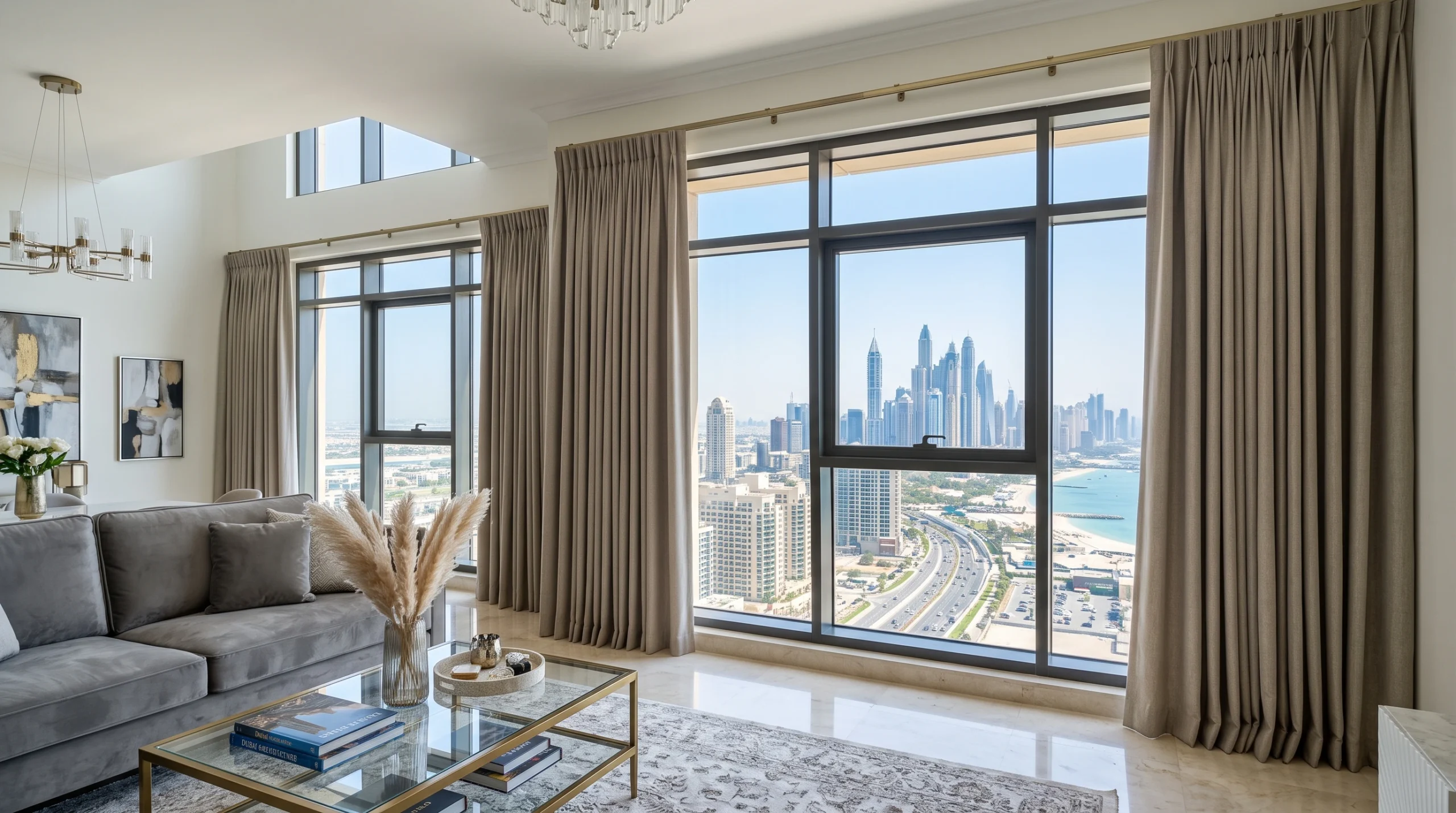
The track is easy to overlook because it becomes visually secondary once the curtain is installed. Yet the track determines how smoothly the curtain moves and how well the finished treatment works. Inverted pleat curtains can be installed with appropriate curtain tracks, depending on the construction of the heading and the hardware selected.
For wide windows, a quality aluminium track can provide smooth movement and reliable support. For concealed installations, the track can sit inside a ceiling pocket or behind a pelmet. Moreover, for ordinary rooms, a visible track can still work if its finish complements the interior.
Professional installation also matters because even a perfectly sewn curtain can look wrong if the track is poorly positioned. Current Dubai made-to-measure services commonly include measurement, track selection and professional fitting as part of the process.
Motorized Inverted Pleat Curtains Dubai
Motorization is especially practical for large Dubai windows. Imagine trying to pull a six-metre curtain across a living-room glass wall every morning. It is possible, but why make daily life harder when a motorized track can open and close the curtains at the touch of a button?
Motorized systems can be particularly useful for high windows, double-height rooms, large villas and smart-home installations. Current Dubai suppliers list motorized curtains as a premium option, with 2026 published starting prices varying substantially depending on the curtain type, size and motor system. The curtain heading itself does not make the system smart; the motorized track and compatible control system provide that functionality.
How Much Do Inverted Pleat Curtains Cost in Dubai?
There is no single fixed price for inverted pleat curtains Dubai because custom curtains are priced according to several variables. Published 2026 Dubai market examples put standard custom curtain projects anywhere from a few hundred dirhams per window to well above AED 1,000 for premium fabrics and more complex configurations. One recent UAE guide places many standard made-to-measure curtains between AED 250 and AED 1,200 per window, while another Dubai supplier lists pinch-pleat/linen-pleat curtains from AED 1,144 and layered premium sets from AED 2,680.
These figures should be treated as market examples rather than a fixed tariff for inverted pleats. The final quotation depends on the window dimensions, fabric, lining, fullness, number of panels, track, installation and optional motorization.
Main Factors That Affect Curtain Prices
| Cost Factor | Why It Matters |
|---|---|
| Window width | Wider windows require more fabric and longer tracks |
| Curtain height | Taller drops increase fabric consumption |
| Fullness | More fullness means more fabric |
| Fabric | Linen, velvet, jacquard and premium fabrics cost more |
| Lining | Blackout and thermal layers add material |
| Track | Basic and premium tracks have different costs |
| Motorization | Adds motor, controls and installation |
| Installation | Complex ceilings and large windows require more work |
| Number of layers | Sheer plus blackout costs more than one layer |
If you receive two dramatically different quotations, do not compare only the final number. Compare the fabric specification, fullness, lining, track, installation and warranty. A cheaper curtain may simply contain less fabric or a lower-grade track.
Best Colours for Inverted Pleat Curtains
Neutral colours remain a safe choice for Dubai interiors because they work with marble, wood, stone, metallic finishes and contemporary furniture. Ivory, warm white, beige, sand, taupe, greige and soft grey can all create an understated look. These shades are particularly effective when the goal is to make the architecture and furniture remain the stars of the room.
That does not mean colour should be avoided. Deep olive, navy, charcoal, terracotta and muted blue can create a strong accent without becoming overwhelming. For a formal majlis or luxury living room, a darker curtain can add depth and make a large space feel more intimate.
Always examine fabric samples in the actual room. Dubai daylight changes dramatically throughout the day, and a colour that looks cool under showroom lighting may appear much warmer under afternoon sunlight. A home consultation with physical samples can therefore be more reliable than choosing a fabric solely from a digital screen.
Inverted Pleat Curtains for Bedrooms
Bedrooms require a different balance between appearance and performance. You want the curtains to look calm and luxurious, but you also want privacy and appropriate light control. An inverted pleat blackout curtain can provide a clean appearance without the decorative heaviness of some traditional headings.
For master bedrooms, consider a dual-layer design. A sheer curtain can soften daylight during the morning and daytime, while the blackout layer can close at night. For children’s bedrooms, practical washable fabrics and reliable tracks may be more important than premium decorative materials.
Colour matters here too. Soft neutrals can create a restful environment, while darker shades can create a cocoon-like atmosphere. The most important thing is consistency with the room’s flooring, wall colour, upholstery and bed design.
Inverted Pleat Curtains for Living Rooms and Majlis
Living rooms offer more freedom because light control and privacy may be less demanding than in bedrooms. Here, inverted pleats can be used as an architectural finishing element. A full-height curtain can frame the window, soften hard surfaces and introduce texture into a room filled with marble, glass and metal.
For a majlis, fabric selection becomes particularly important. Rich velvet, textured jacquard or a high-quality heavier blend can create a more formal atmosphere. In a contemporary majlis, however, a plain linen-look fabric in a sophisticated neutral can produce a much cleaner result.
The trick is not to choose the most expensive fabric automatically. Choose the fabric that supports the design story of the room. A beautifully made curtain in a suitable mid-range fabric can look more sophisticated than an expensive fabric that clashes with the furniture.
How to Measure Windows for Custom Curtains
Accurate measurement is one of the biggest differences between ready-made curtains and professional made-to-measure curtains. Dubai windows can vary dramatically in width, height and configuration, particularly in villas and modern apartments. Current made-to-measure services emphasize measurements such as width, drop, stack-back space and heading height because each affects the final installation.
For a professional quotation, the installer should assess more than the glass itself. They should consider the wall width, ceiling height, window recess, handles, air-conditioning units, furniture placement, track location and the amount of space available for the curtains when open.
Do not simply measure the glass and order fabric based on that number. The curtain usually extends beyond the glass to improve coverage and reduce light gaps. The exact allowance depends on the installation and design, which is another reason an on-site survey is preferable for custom work.
How to Maintain Inverted Pleat Curtains
Maintenance depends on the fabric. Some curtains can be gently vacuumed with an upholstery attachment, while others may require professional cleaning. Avoid washing a made-to-measure curtain at home unless the care instructions specifically allow it because shrinkage can affect the carefully calculated drop and pleat structure.
Dust is an important consideration in Dubai. Regular gentle dust removal can prevent particles from becoming embedded in the fabric. If the curtains are positioned in a high-sun area, also pay attention to signs of fading and consider lining options when replacing or upgrading window treatments.
The pleats themselves should not be aggressively pressed or pulled. Their structure forms part of the curtain’s tailored appearance, so rough handling can distort the folds over time. A good installation and appropriate fabric care will help the curtain maintain its intended appearance for much longer.
How to Choose a Curtain Company in Dubai
Choosing the right curtain company is about more than finding the lowest price. Start by looking for a supplier that offers made-to-measure curtains, on-site measurement and professional installation. Ask to see physical fabric samples and request a detailed quotation showing the fabric, lining, fullness, track and installation.
A professional supplier should also be able to explain why a particular fabric or lining suits your room. If you have a west-facing window, they should discuss sunlight. If you have a very wide glass wall, they should discuss track strength and panel configuration. Moreover, if you want motorization, they should explain the motor and control options rather than simply adding a premium number to the quotation.
Turnaround time is another consideration. Current Dubai suppliers advertise anything from a few days to around two weeks depending on the service and customization level. Ask for the expected timeline before placing the order, particularly if the curtains are part of a larger renovation or move-in schedule.
Conclusion: Are Inverted Pleat Curtains Right for Your Dubai Home?
Inverted pleat curtains Dubai are an excellent option if you want a sophisticated window treatment with a clean, tailored appearance. Their inward-folding construction creates a flatter visual front than traditional pinch pleats, making them especially compatible with modern apartments, contemporary villas, executive offices and minimalist interiors. They can be paired with sheer, linen, velvet or blackout fabrics and can also be installed on motorized tracks for large or difficult-to-reach windows.
The most important decision is not simply choosing inverted pleats. Think about the complete system: fabric, fullness, lining, track, installation, colour and room function. A beautifully designed curtain should look good when closed, stack neatly when open and perform properly throughout the year.
For Dubai homes, customization is particularly valuable because floor-to-ceiling glazing, tall ceilings and large window spans are common. Current market pricing confirms that custom curtains vary widely depending on specifications, so comparing the complete package rather than the headline price is the smarter approach.
If you want a curtain style that feels luxurious without looking overly traditional, inverted pleats are certainly worth considering.
FAQs About Inverted Pleat Curtains Dubai
Inverted pleat curtains feature folds that turn inward toward the back of the curtain rather than forming prominent outward-facing pleats. This creates a relatively flat, clean front and gives the curtain a contemporary appearance. They are commonly used in modern interiors where homeowners want structured curtains without a heavily decorative heading.
Yes. The pleat style itself does not determine climate performance; the fabric and lining do. For rooms exposed to strong sunlight, consider blackout or suitable lined fabrics, while sheer curtains can work well when you primarily want to filter daylight. For particularly sunny windows, discuss the appropriate lining with your curtain specialist.
The price depends on the window dimensions, fabric, fullness, lining, track and installation. Current 2026 Dubai pricing examples show standard custom curtain projects ranging from several hundred dirhams per window to more than AED 1,000 for premium specifications. A precise quotation requires the actual window measurements and chosen specifications.
Yes. Inverted pleat curtains can be paired with suitable motorized curtain tracks. Motorization is particularly useful for large windows, floor-to-ceiling glass, double-height rooms and smart homes. The motor and track are separate from the fabric heading, so the supplier should confirm compatibility before manufacturing the curtains.
Neither style is universally better. Inverted pleats create a cleaner and more contemporary appearance, while pinch pleats offer a more traditional and decorative look. If your Dubai home has minimalist furniture and modern architecture, inverted pleats may blend more naturally; if you have a classic or formal interior, pinch pleats may be the better match.