
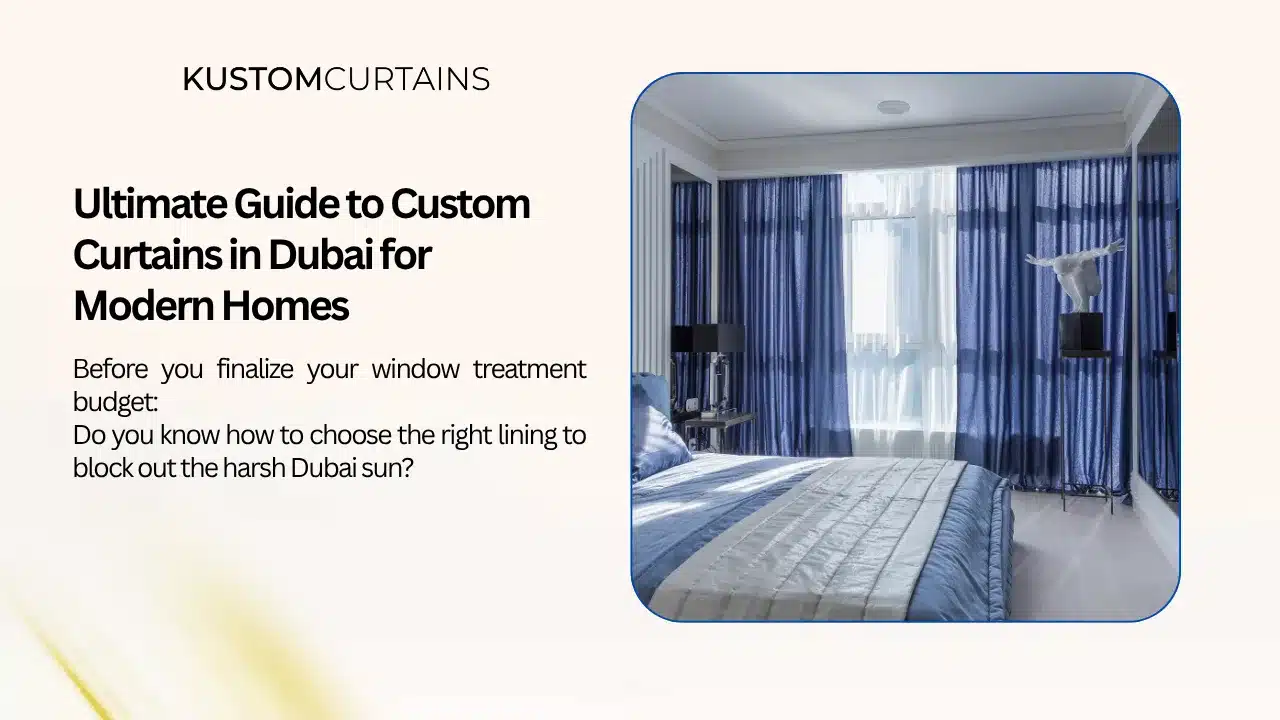
You moved into the apartment six months ago. The temporary curtains you ordered online – the ones that arrived three weeks late and hung two inches too short – are still there. Every afternoon the western sun pours through the gap and the living room turns into something you can only describe as an oven. You know you need to sort it. You just haven’t figured out where to start, who to trust, or what it’s all going to cost. That, in broad terms, is where most Dubai residents are when they start looking into custom curtains. This guide is for you.
Why Made-to-Measure Matters More in Dubai Than Almost Anywhere Else
Window Proportions in Dubai Buildings
Standard off-the-shelf curtains are designed around European and North American window proportions. Dubai’s residential buildings – particularly the towers in Business Bay, JBR, and Downtown – routinely feature floor-to-ceiling glazing that runs two-point-four to three metres from slab to ceiling. Villas in Arabian Ranches and Mirdif often push that further, with statement windows spanning four to five metres across. No retail panel is going to cover that cleanly.
UV Intensity and Fabric Durability
There’s also the sun to contend with. Dubai sits at roughly 25 degrees north latitude, meaning summer UV intensity is punishing. From April through October, direct sun exposure can fade a standard curtain fabric in as little as eighteen months. Made-to-measure suppliers working in the UAE market stock solution-dyed and UV-stabilised fabrics as standard – the kind of technical specification you simply won’t find on the shelves of a high-street homeware store.
Building Management Rules
The third reason is one that surprises people: building management rules. Many freehold towers in Dubai Marina, JLT, and Palm Jumeirah specify that window treatments visible from outside must be a neutral or white-facing colour. This is written into the OA (Owners’ Association) regulations and can trigger a formal notice if you get it wrong. A good curtain specialist will know which buildings have these rules and factor the fabric choice accordingly.
Getting the measurements right from the start saves money. A standard ready-made panel bought online and hemmed locally costs more in time and stress than a made-to-measure set measured, made, and hung in one appointment sequence.

Fabric Selection: What Holds Up and What Doesn’t
Performance Fabrics for Dubai Climate
Dubai’s climate is not kind to fabric. The combination of intense UV, temperatures above 45°C on balcony-facing windows, and the humidity spike that comes with the coastal air in areas like JBR means you’re choosing fabric for performance as much as aesthetics.
Solution-dyed acrylic and high-density polyester weaves are the workhorses of the UAE curtain industry for good reason. The dye goes into the fibre during manufacture rather than being applied to the surface, which makes it structurally resistant to fading in a way that surface-dyed fabrics simply cannot match. For a villa in Arabian Ranches with a south-west facing majlis or a large living room, this matters enormously.
Natural Fibres and Lining Solutions
Natural fibres – linen, cotton, silk – aren’t off the table, but they need managing. A good quality blackout or thermal lining on the back of a natural-weave fabric does two things: it protects the face fabric from UV degradation, and it adds a layer of insulation that meaningfully reduces the solar heat gain coming through the glass. In a DEWA-metered apartment where you’re paying your own electricity bills, that insulation is not a luxury. The energy saving across a Dubai summer is real.
Role of Sheer Fabrics
Sheer fabrics have a particular role in Dubai homes that people often underestimate. A well-chosen sheer – a flat-weave voile or a fine linen blend – filters the harsh direct light while preserving the view. In a high-floor apartment in Downtown or Business Bay where the view is part of what you paid for, layering a sheer under a main curtain gives you full flexibility: full privacy and blackout when needed, or soft filtered light when you want to keep the city visible.
Fabric Weight and GSM Guidelines
For the heading fabric and its weight, ask your supplier for the GSM (grams per square metre). A heavier fabric of 280–350 GSM hangs better, drapes more luxuriously, and insulates more effectively. Lightweight fabrics under 150 GSM can look insubstantial, especially in a larger Dubai villa room with high ceilings.

Track Systems, Headings, and Why the Hardware Matters
Budget Allocation Between Fabric and Hardware
Most people put ninety percent of their budget consideration into the fabric and ten percent into the track. This ratio should be closer to seventy-thirty. A beautiful fabric on a poor track system looks worse than a modest fabric on a well-engineered one.
Ceiling-Mounted Ripple-Fold Tracks for Apartments
For Dubai apartments, ceiling-mounted ripple-fold tracks have become the default among designers and interior fit-out teams for a reason. The ripple-fold heading creates a consistent, contemporary wave that works in almost every interior style – from the marble-and-chrome aesthetic common in Palm Jumeirah properties to the warmer, more textured interiors found in villa communities like Damac Hills or Jumeirah Park. Ceiling mounting also draws the eye upward and makes rooms feel taller, which matters in standard Dubai apartment builds with 2.7 metre ceiling heights.
Track Requirements for Large Villa Spans
For villas with larger spans – anything above three metres wide – the track quality becomes critical. Cheaper aluminium extrusions flex under the weight of heavy fabric and begin to bow, which means your curtain will never hang flat again. Specify a reinforced steel-core or double-extrusion aluminium track on any span over three metres.
Motorisation Options and Costs
Motorisation is worth discussing honestly. It’s not a luxury add-on in Dubai – it’s a practical solution for windows that are physically difficult to reach, for large villas where opening and closing curtains at either end of the house is genuinely inconvenient, or for landlords and Airbnb operators who want to offer a premium feel. A basic Somfy or Dooya motor system adds roughly AED 350–650 per track depending on width. Smart home integration with Google Home or Alexa compatibility is available and adds perhaps AED 200–400 to that figure. For a full villa automation package across eight to ten windows, budget AED 4,000–6,500 for the motor system alone before fabric.

Understanding Pricing: What You’re Actually Paying For
Market Fragmentation and Quote Types
Pricing for custom curtains in Dubai is genuinely confusing because the market is fragmented. You have large souk-based operations in Satwa and Karama quoting per-metre fabric prices with installation, tailoring, and track system quoted separately – and often revised upward when the job is on the wall. You have mid-market suppliers in Al Quoz and Arjan offering bundled pricing with everything included. And you have online-only operators who require you to self-measure, accept no responsibility for measurement error, and arrange your own installation.
Typical Costs for Apartments
For a standard Dubai two-bedroom apartment – two bedrooms and a living room – expect to spend between AED 2,800 and AED 6,500 for a mid-range fabric solution with professional installation included. Blackout bedroom curtains with quality lining and a ceiling track run roughly AED 900–1,500 per window depending on dimensions. Motorised options sit towards the upper end and beyond.
Factors Affecting Price
The things that drive prices up are: large window spans requiring reinforced track systems, imported European fabric, motorisation, and complex heading styles requiring more fabrication time. The things that are often hidden in cheaper quotes are: lining charged separately, track hardware excluded, or installation billed as a day rate after the fact.
Full Villa Project Costs
A full-villa project in Arabian Ranches or Jumeirah Golf Estates – covering a majlis, formal dining room, family room, master bedroom, and three to four secondary bedrooms – typically runs AED 15,000–35,000 depending on fabric tier and whether motorisation is specified throughout. These are wide ranges because villas vary enormously in window count and glazing area. The only way to get an accurate number is to have someone measure the property.

Installation: What Good Looks Like
Professional Installation Standards
A professionally installed curtain should be level to within two millimetres across its full span. The hem should clear the floor by no more than half a centimetre, or pool by a consistent fifteen to twenty centimetres if a pooling style has been specified. The pleats or ripple folds should be even and consistent. The track gliders should run silently. These are not unreasonable expectations – they’re what separates a professional installation from an amateur one.
Challenges in Different Building Types
In Dubai’s older residential buildings, ceiling installation can be complicated by concrete slab construction. Good installers carry a range of fixings for this – chemical anchors, specialist concrete fixings – and know how to achieve a secure, clean ceiling mount without causing damage that a landlord or building management would flag. In newer towers and villas, the installation is generally more straightforward, but it still requires the right tools and experience to do it neatly.
Questions to Ask Suppliers
Ask any supplier you’re considering whether installation is included in their quote and whether it covers all materials – wall plugs, track end caps, bracket covers. Ask who does the installation: the supplier’s own team, or a subcontracted crew? The answer matters because warranty claims become complicated when the measuring team and installation team are different people from different companies.
Expected Timelines
Timelines are worth setting expectations on. A 48–72 hour turnaround is achievable on standard fabrics that are locally stocked – useful if you’re completing a fit-out, moving in on a deadline, or need something done before Ramadan or a summer holiday. Imported fabric orders, particularly from European mills, realistically take three to four weeks from order to installation. Any supplier promising two-day delivery on an imported fabric quote is either overstating their stock or underdelivering on fabric quality.
Common Mistakes Dubai Homeowners Make and How to Avoid Them
Mistake 1: Ordering Before Proper Measuring
The most expensive mistake is ordering before measuring. It seems obvious, but a surprising number of Dubai residents buy curtains from an online supplier using window frame dimensions rather than the full ceiling-to-floor and wall-to-wall measurements needed for a professional installation. Made-to-measure means measured – by someone who knows what they’re doing, with a laser measure, in person.
Mistake 2: Ignoring Light Direction
The second most common issue is choosing fabric without accounting for light direction. A sheer that looks beautiful in a north-facing showroom can look translucent and gauzy in a south-facing Dubai room at noon in July. Always ask to see a large fabric sample in the actual room, at the actual time of day when the issue is most acute, before committing.
Mistake 3: Neglecting Lining Choice
Neglecting the lining choice is another. People select a heading style and a fabric and forget about lining entirely until they’re asked to sign off a quote. Lining is not an afterthought – it’s what makes the curtain perform in Dubai’s climate. Interlining (a third layer of wadded fabric between face and lining) is available for rooms where maximum thermal insulation is needed and makes a genuine difference to room temperature in west-facing bedrooms during summer.
Mistake 4: Over-Reliance on Hard Negotiation
Finally: don’t let the souk mentality lead you into corners. The tradition of hard negotiation in Dubai’s fabric markets exists for a reason – margins are historically high and prices are often inflated to accommodate discounting. But the trade-off is that suppliers who’ve been negotiated into thin margins cut corners elsewhere: on lining quality, on track hardware, on installation crew. A transparent, fixed-price quote with full specification itemised is usually better value than a discounted bundled price with undefined scope.
Frequently Asked Questions
For a typical Dubai two-bedroom apartment, expect AED 2,800–6,500 with installation included. Full villa projects run AED 15,000–35,000 depending on fabric tier and window count. Any figure given without an in-home measurement is a starting point, not a commitment.
Solution-dyed acrylic and tightly woven polyester blends hold up best against UAE UV. Natural fibres work with a quality lining behind them — the lining protects the face fabric and cuts solar heat gain at the same time.
48–72 hours on locally stocked fabrics. Imported European fabrics run three to four weeks. Confirm lead times before ordering if you’re working to a move-in or fit-out deadline.
In most cases, yes. Ceiling-mounted tracks can be fixed without causing lasting structural damage. Check your tenancy agreement or OA regulations first, and if permanent fixing isn’t an option, tension rod systems are available.
You’ve done the research. You know what you want, probably a ceiling-mounted track, something with a quality lining for the bedroom, sheers for the living room. The remaining variable is accurate measurements and a price that covers everything without surprises.
Ready to transform your space?
That’s the part we handle. A Kustom Curtains specialist comes to you, anywhere in Dubai, with fabric samples across every category covered in this guide, a laser measure, and the experience to advise on exactly what will work in your specific rooms and your specific light conditions. The quote you receive on the spot covers fabric, lining, track hardware, and professional installation. No separate billing for fitting. No surprise charges after the crew leaves. Everything carries a twelve-month warranty.
If you’re ready to move forward or just want to see samples before committing to anything, that’s a perfectly good reason to book a home visit. There’s no obligation and no pressure, a lot of clients take a few days to think after the consultation before confirming. That’s fine. We’d rather you make the right choice than a fast one.
WhatsApp +971 52 582 8041 or book your free home visit at kustomcurtains.ae .